

Saving Telco Customers or Not Using a Churn Save Agent
You're reading the second entry in a series where I ship a small agentic AI build every week, alternating between Financial Services and TMT. This week we're focusing on TMT problem in telco marketing operations.
Business Case
Every mobile carrier — T-Mobile, AT&T, Sprint, MTN, Etisalat, and many others — typically runs a "retention" or "churn-save" function to preserve its customer base. The aim of the model is to ensure that "valuable" customers are retained to protect business revenue, while others are allowed to leave — because there are times when a customer is more expensive to keep than to lose. The model flags subscribers who look likely to leave — a sudden drop in data usage, a call to a competitor's port-in line, a string of support complaints — and a team has to decide, fast, what to do about each one. Do nothing? Send a small loyalty perk? Offer a bill credit? Throw an aggressive discount to win them back?
Agents working in collaboration with humans can help automate and fast-track these processes, supporting the retention agents, marketing-ops analysts, and commercial teams who set offer policy.
In today's example, we'll focus on an agentic system that recommends what action to take for a given customer, using sample data to illustrate how these systems would work.
Inside the build
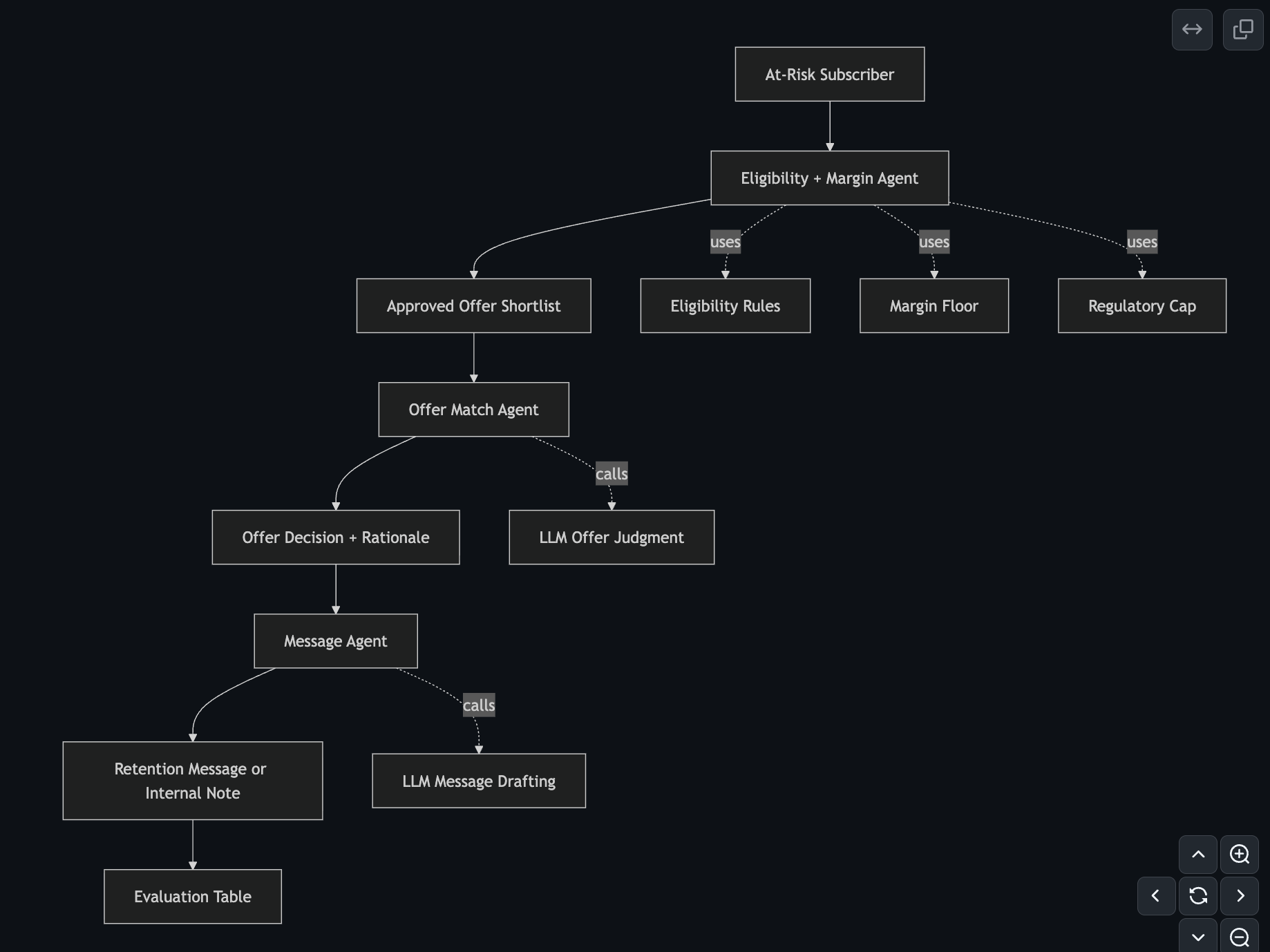
An agentic system ingests flagged at-risk subscribers and outputs, per subscriber: a recommended save offer, an eligibility-and-margin check, and a drafted retention talk-track, each with rationale. The system consists of:
Orchestrator Agent— routes each subscriber through the pipeline and carries an audit trace.
Eligibility Margin Agent — a deterministic model that applies eligibility, margin-floor, and regulatory checks; produces the shortlist of allowed offers.
Offer Match Agent — an LLM as a judge that picks the cheapest effective intervention from that shortlist.
Message Agent — a LLM generation agent drafts brand-neutral, compliant copy for the chosen offer.
The system is built on LangGraph with an OpenAI model, tested against a small synthetic set of seven subscribers spanning the cases that matter (high-value port-out, low-risk false flag, low-ARPU margin trap, service-driven churn, and so on).
I used an AI-native engineering workflow — Claude, Codex, and similar tools — for implementation, review, and iteration. But the domain framing, the architecture, and every final decision stayed human-led. The tools accelerate the build; they don't set the strategy.
Repo: https://github.com/Oladotun/Telco_MarketingOps_Churn_Save_AgenticAI
Making It Production Ready
This prototype was an example but to make this system production ready, there are steps to take such as :
Data ingestion from billing and CRM systems;
Droader and adversarial evaluation;
Structured and validated outputs;
Full audit logging;
A deterministic policy rules maintained as governed data outside the prompt layer
Human In The Loop reviews for high-risk calls;
live monitoring and a proper commercial-governance framework for offer policy.
Measuring Impact
To evaluate the impact of the solution to drive retention. An A/B test experiment should be held to proof that the offer from the agent led to retention.
Takeaways
Agentic AI in telco commercial ops shouldn't blindly automate the spend decision. It should structure the work — gather the signals, apply deterministic margin and compliance controls, surface an auditable recommendation, and keep a human on the high-risk, high-value calls. The value is augmentation, not replacement.
The vendor pitch to be wary of is the one that promises to "maximize retention" or "automate save offers end-to-end." Maximizing retention is easy and usually unprofitable. The hard, valuable thing is matching the cheapest effective intervention to the real reason someone is leaving — and proving it moved the needle. Anyone selling automation without a margin floor and a holdout strategy is selling you a faster way to lose money.
I publish one of these weekly, rotating across Financial Services and TMT. Next week swings back into FS. If there's a sub-domain you want me to tackle - wealth, payments, insurance, ad-tech, gaming, anything - drop it in the comments. Follow along if you want the rest of the series.